What AWS re:Invent Didn't Tell You About Agentic AI Deployment

Your notebook is full. Your mind is racing.
You just spent the week in Las Vegas at AWS re:Invent 2025, immersed in a dazzling display of technological potential. You saw Swami Sivasubramanian demonstrate how to build “secure, reliable agents.” You listened to Werner Vogels explain how AI is transforming software development. You left with one clear message: The foundational blocks for agentic AI are here, and they are powerful.
So why does a quiet, persistent doubt linger as you board the flight home?
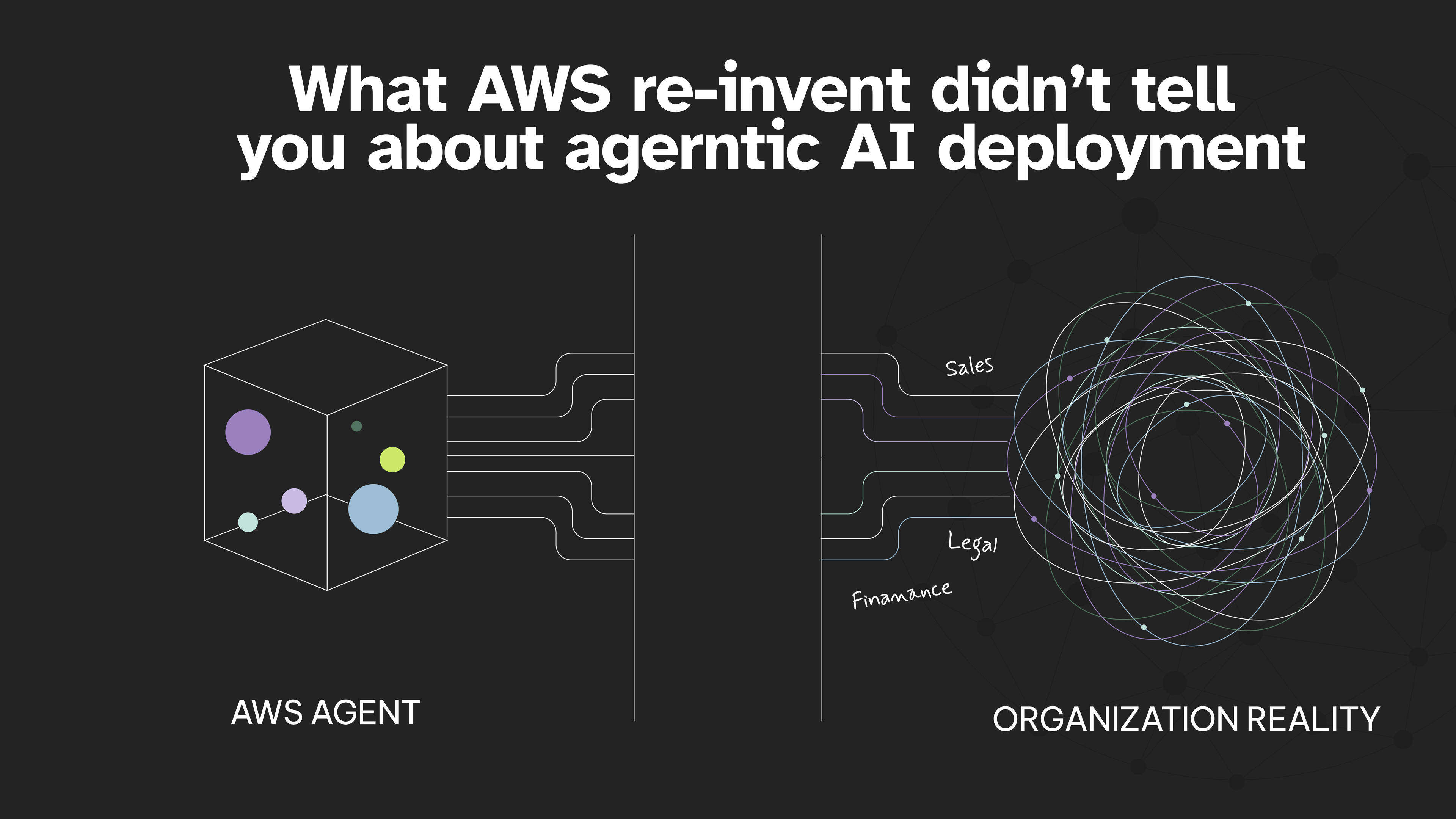
It’s the same doubt that kept you awake during the keynotes. You’d see a brilliant demo of an AI agent automating a finance process, and your mind would jump to the 17 emails, 3 Slack channels, and 2 offline conversations your finance team would need to have with sales and legal to make that process actually work in your organization.
You have been sold the dream of autonomous AI. But you live in the reality of cross-functional friction.
This is the great unspoken truth of AWS re:Invent - the conference was a masterclass in infrastructure, but it was silent on orchestration. It taught you how to build individual actors, but not how to direct the play.
The most critical gap in your AI strategy isn’t a missing AWS service. It’s the missing layer of Organizational Intelligence needed to turn those services into cross-functional business outcomes.
The Infrastructure Illusion
Let’s be clear: what AWS provides is engineering marvel. The compute, the model access through Bedrock, the agent-building tools, they are world-class. They are necessary.
But they are not sufficient.
Think of it this way: AWS sells the finest lumber, the most powerful nails, and the best blueprints for building a single, perfect chair. But you are trying to build a city. A city requires zoning laws, electrical grids, plumbing systems, and traffic coordination. It requires an understanding of how different structures and communities interact.
This is the gap between infrastructure and transformation. Your organization isn’t a single chair; it’s a complex, interconnected metropolis of departments, goals, and people.
The evidence is everywhere, hiding in plain sight. McKinsey reports that while 92% of organizations are increasing AI investment, only 1% have reached a mature, scaled state. The common interpretation is that leaders are moving too slowly. We see a different truth: leaders are aiming at the wrong target.
The misconception is that AI should be designed to replace human judgment. This leads to applying powerful agents to strategic tasks where humans excel, while the mundane, cross-functional burdens that strangle productivity and morale remain untouched.
A BCG study from June 2025 identified a 51% “silicon ceiling” for frontline AI adoption. Why? Because the AI being deployed doesn’t solve the right problems. It’s another tool, another login, another silo. It adds complexity instead of removing friction.
The real work of a business - the quarterly planning, the product launch, the complex sale, doesn’t happen in a single department. It flows, often messily, across them. And your brilliant, isolated AWS agents are blind to this flow.
The Orchestration Gap: From Individual Agents to Cross-Functional Workflows
This is the first thing AWS re:Invent didn’t tell you: individual agent capability does not equal cross-functional workflow success.
You can build a world-class sales agent that qualifies leads with superhuman efficiency. You can build a legal agent that reviews contracts in seconds. You can build a finance agent that processes invoices flawlessly.
But what happens when a qualified lead requires a custom contract that impacts revenue recognition and needs special payment terms?
In most organizations, this triggers a silent, expensive, and deeply human orchestration problem. The sales agent, having done its job, has no native ability to:
- Wake up the legal agent with the right context.
- Securely pull the deal specifics into a draft.
- Involve the finance agent to model the revenue impact.
- Loop in a human expert from sales ops for the final sign-off.
- Ensure every system of record is updated, and every stakeholder is notified.
Without a layer designed for this orchestration, you don’t get a seamless workflow. You get a series of disconnected handoffs. You get agents operating with blind spots. You get the digital equivalent of throwing work over a wall, and you recreate your existing organizational silos in expensive, new AI infrastructure.
The community is feeling this acutely. In the past week, surveys show 42% of executives say AI adoption is "tearing their company apart" due to power struggles and siloed conflicts. The conversation is shifting from “what can agentic AI do?” to the much harder question: “how do we orchestrate cross-functional workflows?”
AWS gives you the actors. You are left to be the director, without a script or a stage manager.
The Memory Chasm: Your Agents Have Amnesia
The second critical omission was about memory. The conversation at re:Invent likely centered on RAG (Retrieval-Augmented Generation) as the solution for context. But here’s the uncomfortable truth: RAG is a filing cabinet, not a memory.
Most AI systems today suffer from organizational amnesia. They operate in three stages of memory immaturity:
- Stage 1: Simple Embeddings (The Index Card): Finding data by simple similarity, with no understanding of relationships.
- Stage 2: RAG (The Filing Cabinet): Pulling a relevant document chunk, but still missing the rich connections between concepts.
- Stage 3: Complex Memory Systems (The Living Brain): This is the frontier. Systems that understand relationships and learn from interactions.
Research demonstrates why this evolution is a quantum leap, not a step forward. A graph-based memory system showed a 26% performance improvement over standard OpenAI models, with 91% lower latency and over 90% token cost savings. The graph variant alone added a 2% lift simply by understanding how pieces of information relate.
Why does this matter for you?
Imagine your sales agent successfully closed a deal with a new client in the manufacturing sector. A week later, your support agent gets a query from that same sector. With a RAG system, the support agent might retrieve a general document about your product. With a graph-based memory system, it would understand the relationship between the new client, the manufacturing sector, the specific features sold, and the potential integration pitfalls. It would act with context, not just data.
The gap: AWS provides the databases (like Amazon Neptune for graphs) and the compute for RAG. But it does not provide a turn-key memory system that learns from organizational interactions and makes that contextual understanding available to all agents, across all functions. An agent in customer service has no memory of what an agent in product development learned yesterday. This is why your agents can feel “dumb.”
The Data Modeling Blind Spot: Fueling Your AI with the Wrong Fuel
The third silent gap is in the data itself. The infrastructure keynotes rightly emphasize data. But they focus on data engineering, models optimized for transactional integrity, storage efficiency, and rigid schemas.
Data modeling for AI consumption is a fundamentally different discipline.
Engineering Data Models (For Databases)
- Optimized for transactional integrity
- Normalized for storage efficiency
- Schema-rigid for consistency
AI-Consumption Data Models (For Agents)
- Optimized for on-the-fly understanding
- Denormalized for query performance
- Schema-flexible for context adaptation
There’s a trade-off. AI-optimized models might create some engineering maintenance headaches, but they dramatically improve AI agent performance and decision-making speed. Cross-functional agentic workflows require real-time data access across silos; traditional data warehousing is often too slow and brittle for autonomous agents.
AWS helps you store your data. It doesn’t tell you that you need to remodel it as an Enterprise Knowledge Graph, an AI-optimized structure that maps your organization’s people, processes, and knowledge as a network of relationships, to fuel true Organizational Intelligence.
The Salfati Lens: Introducing the Organizational Intelligence Layer
So, you return from Las Vegas with the world’s best lumber, nails, and blueprints. Now what?
You need an architectural firm. You need a general contractor. You need the layer that turns components into a functioning, intelligent city.
This is the layer Salfati Group provides: the Organizational Intelligence Platform.
We don’t compete with AWS. We complete the picture AWS can’t address. Our platform acts as the conductor for your orchestra of agents, the memory for your organization, and the architect for your AI-optimized data.
Here’s how we help you bridge the gap AWS re:Invent revealed:
- We Diagnose Your True AI Maturity. We move beyond infrastructure with our 4-pillar framework, assessing your Strategic, Infrastructure, Data, and Team Maturity to pinpoint exactly where your orchestration gaps lie.
- We Orchestrate Cross-Functional Workflows. Our platform is designed from the ground up to define, manage, and govern workflows that span your departments. We provide the “traffic control” that allows your sales, legal, and finance agents to collaborate seamlessly on complex processes.
- We Install an Organizational Memory. It learns from every interaction, ensuring that the knowledge gained in one corner of your business benefits the entire organization.
- We Remodel Your Data for AI. We help you build and manage the Enterprise Knowledge Graphs that turn your siloed data into a connected, AI-ready knowledge network, enabling the multi-hop reasoning that agents need to be truly intelligent.
The result is not just incremental efficiency. It’s transformation. It’s your finance team spending 70% less time on data reconciliation and 40% more time on strategic analysis. It’s your entire organization learning, adapting, and executing with a coherence that becomes your most powerful competitive advantage.
Your Next Step: From re:Invent Attendee to AI Transformer
The excitement of AWS re:Invent is real. The technology is powerful. Your doubt is valid. The path forward is not to build more isolated agents, but to build the intelligence that connects them.
Ask yourself these questions now, while the lessons of Vegas are still fresh:
- Where in my organization does work consistently get stuck between teams, not within them?
- Do my AI initiatives have a clear plan for cross-functional orchestration, or are they creating new, more sophisticated silos?
- Is our data structured for transactional integrity, or for AI consumption and real-time agentic decision-making?
The organizations that will lead the next decade are not those that bought the best AWS services. They are the ones who built the best Organizational Intelligence.
You have the infrastructure. Now, let’s build the layer that makes it matter.
Elevate your OI understanding and strategy with our new whitepaper “Beyond Infrastructure: The Organizational Intelligence Blueprint for Turning AI Capabilities into Unfair Advantages”.